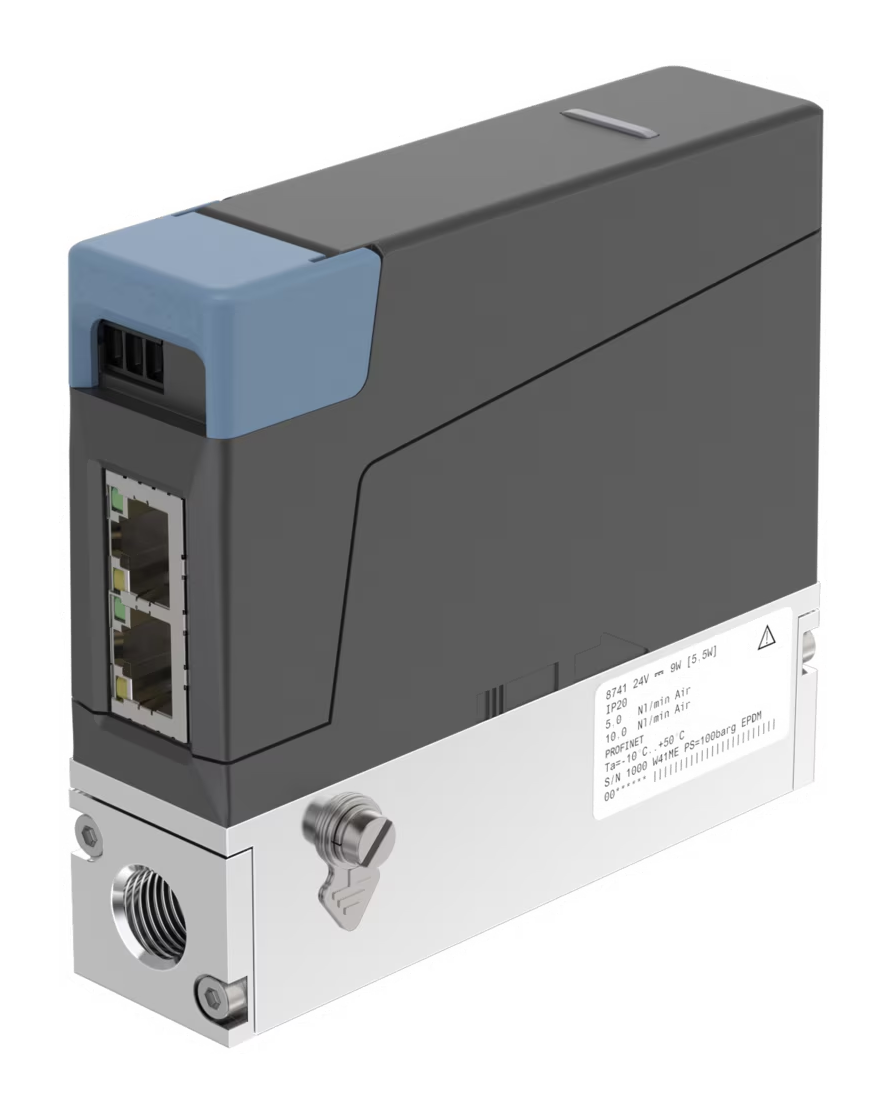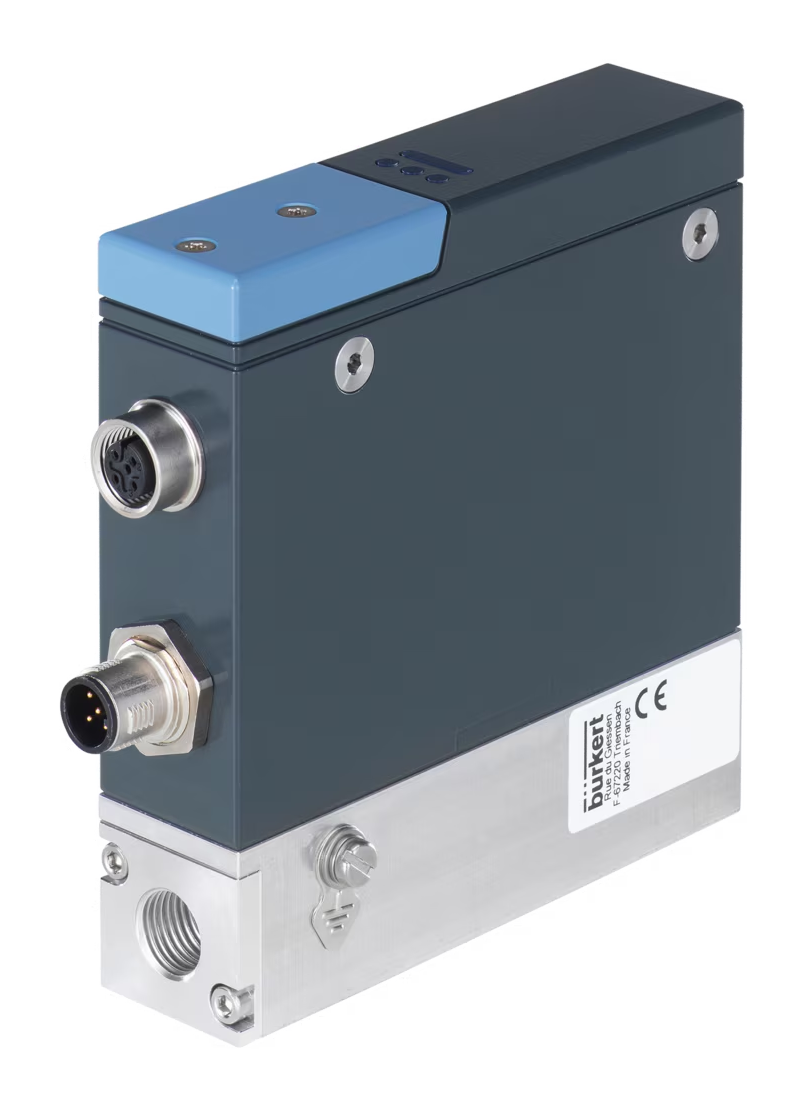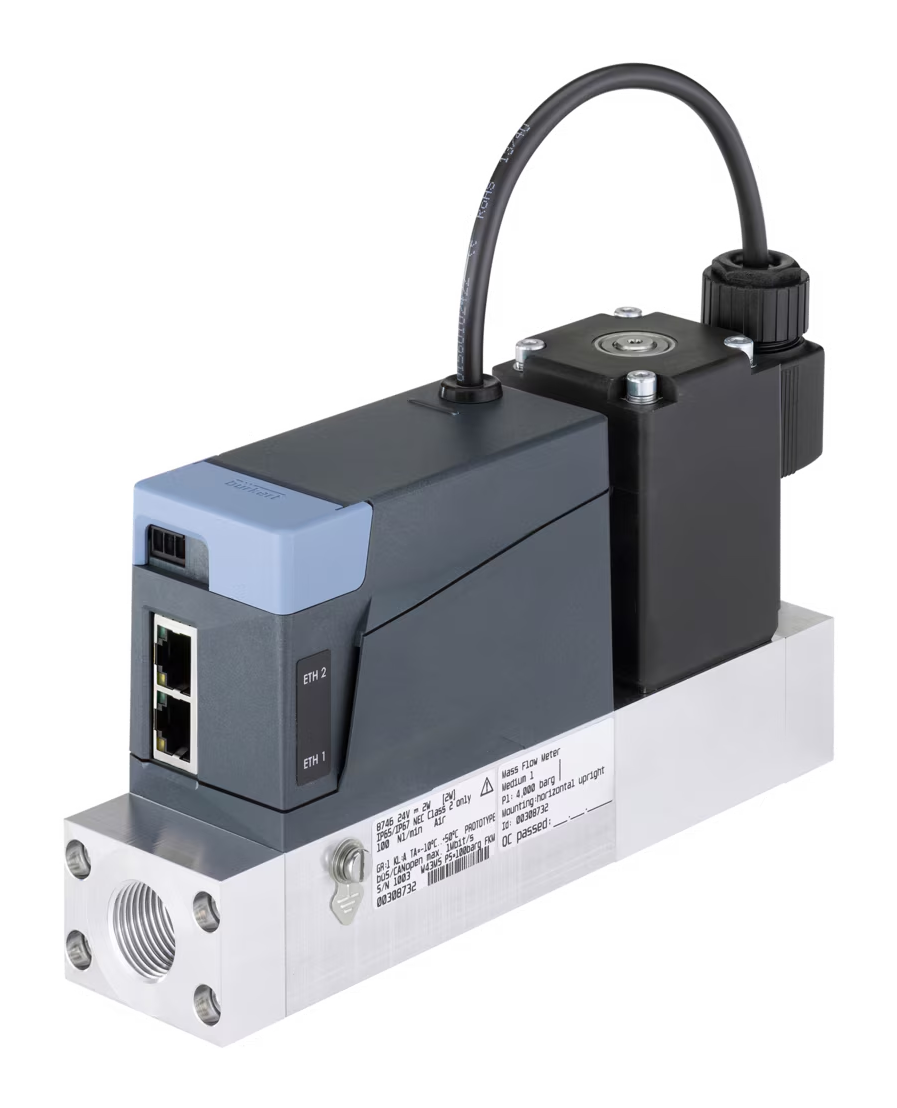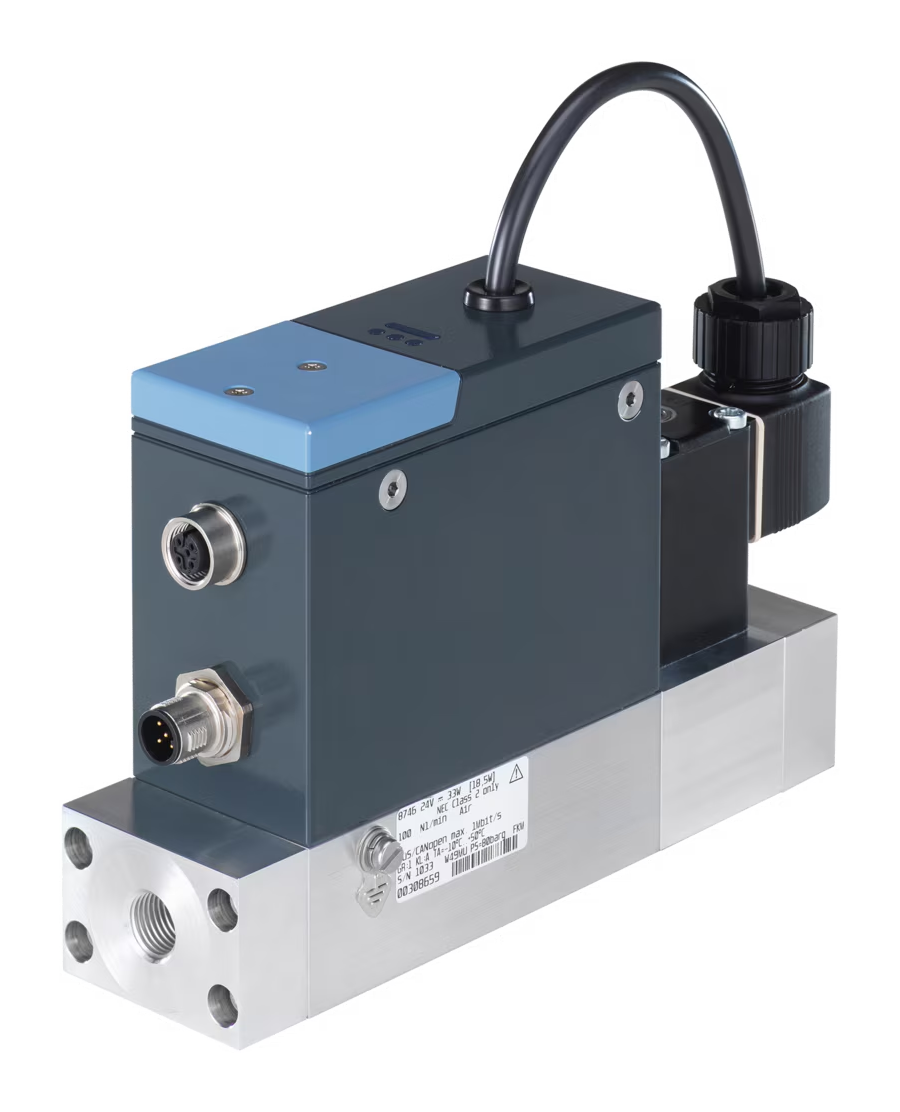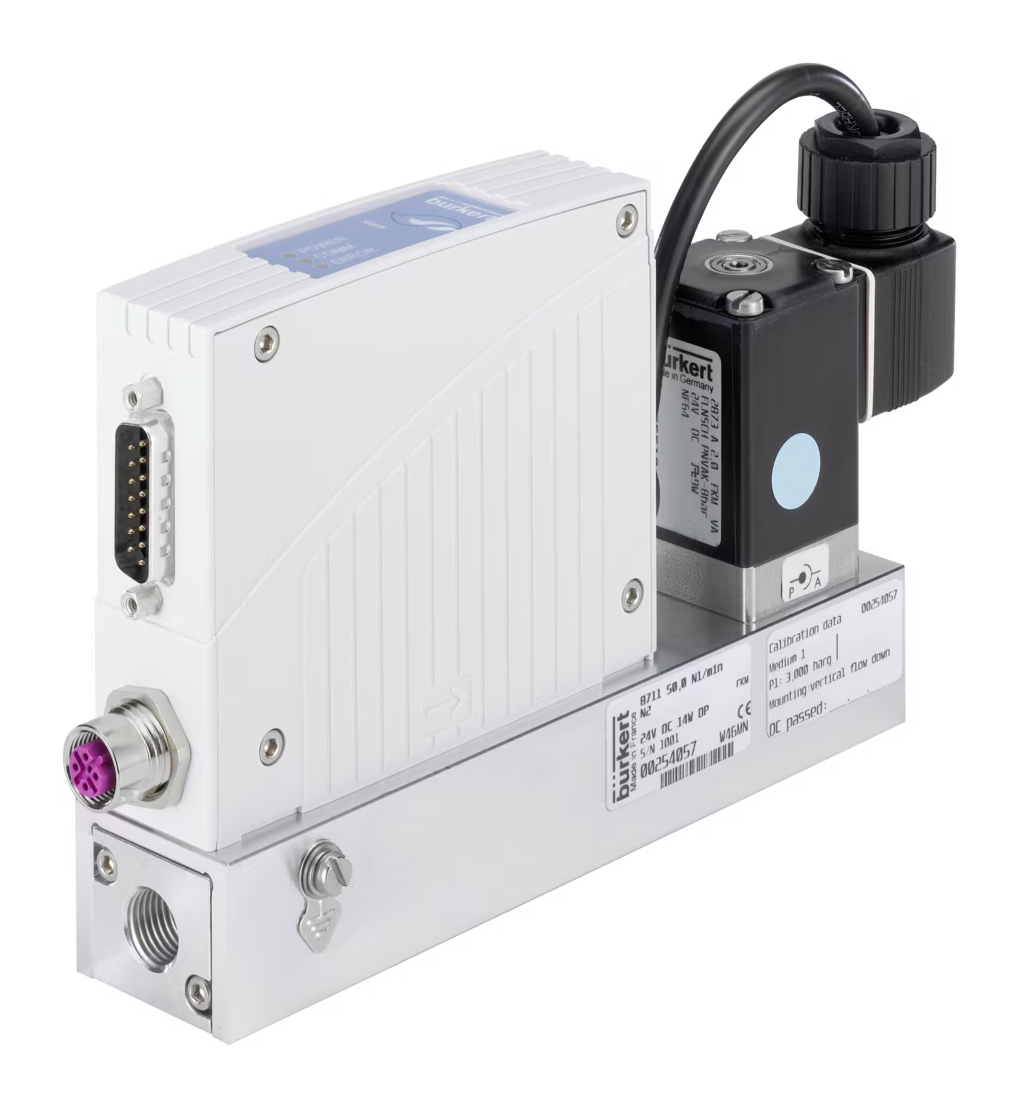
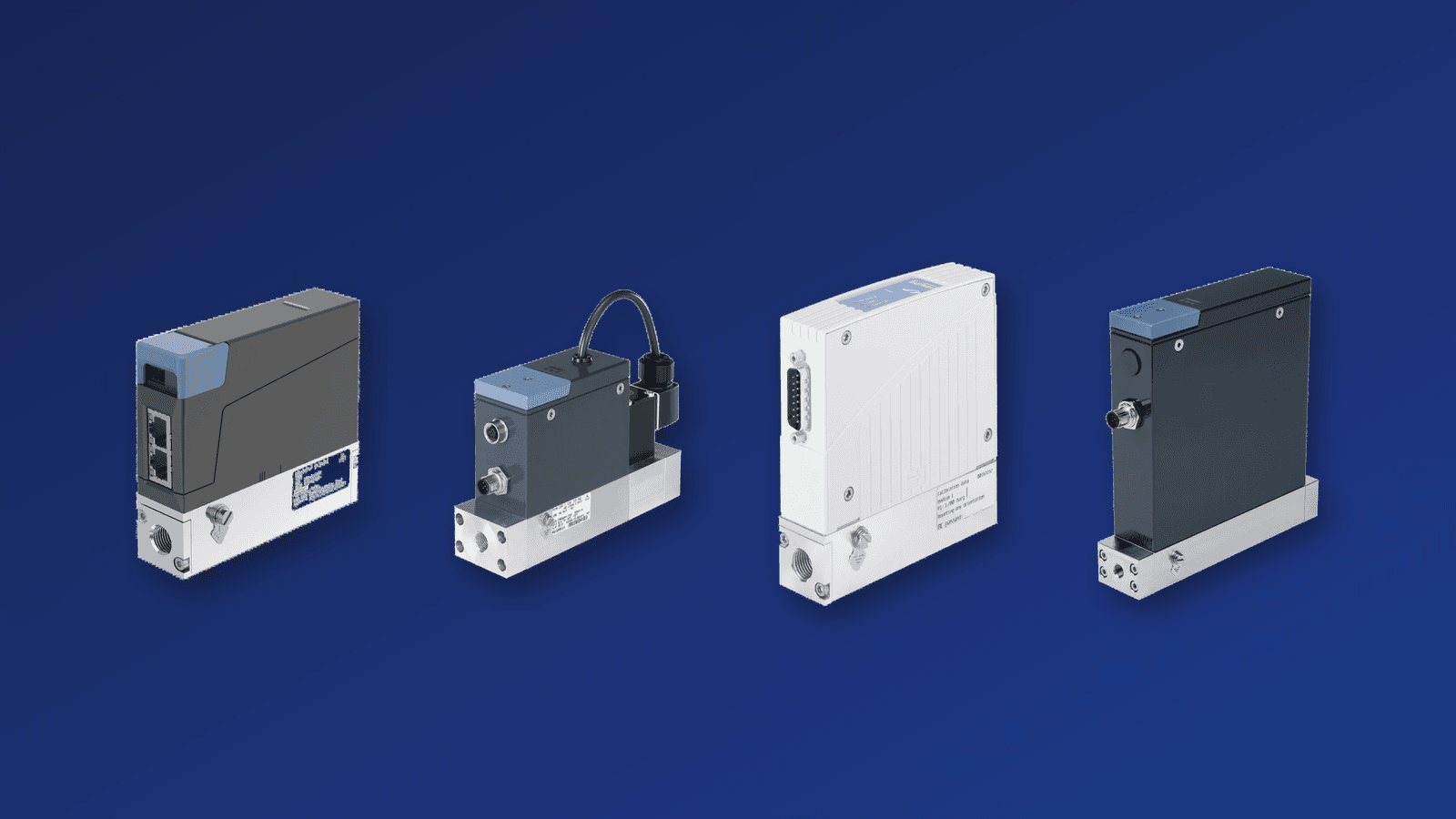
Mass flow controller vs mass flow meter: the hardware looks almost identical, but one only measures and the other measures and controls. Knowing which you need, and which Bürkert model covers your flow range, saves both money and commissioning time.
This guide explains how thermal MFCs and MFMs work and compares Bürkert's gas range, from the low-flow Type 8741 to the high-flow Type 8746, plus the Coriolis Type 8756 for liquids.
MFM vs MFC in one sentence each
- A mass flow meter (MFM) measures the mass flow of a gas and outputs it as a signal.
- A mass flow controller (MFC) adds a proportional valve and a controller, so it holds the flow at a setpoint.
Measuring mass rather than volume means the reading does not drift with gas pressure and temperature, which is why MFCs are used for gas mixing, burners, coating, fermentation and test benches.
How Bürkert thermal sensors work
Bürkert's gas MFCs and MFMs use thermal sensors located directly in the gas stream, which Bürkert says gives very fast response times. Several models can store more than one gas calibration. The controllers use a Bürkert direct-acting proportional valve as the actuator for high response sensitivity, and the high-flow 8745 and 8746 also offer motor-driven valve actuation.
The Bürkert gas range by flow
| Bürkert type | Function | Published nominal flow range | Notes |
|---|---|---|---|
| 8741 | MFC / MFM | 0.010 to 160 lN/min (N₂) | Industrial Ethernet, analogue or fieldbus |
| 8742 | MFC / MFM | 0.010 to 160 lN/min (N₂) | Harsh environments, high IP, ATEX option |
| 8745 | MFC / MFM | 20 to 2,500 lN/min (N₂) | Up to four calibration curves |
| 8746 | MFC / MFM | 20 to 2,500 lN/min (N₂) | Harsh environments, ATEX option |
| 8711 | MFC | 0.010 to 80 l/min | Thermal MEMS sensor |
| 8701 | MFM | 0.010 to 80 l/min | Thermal MEMS sensor |
| 8626 | MFC | 20 to 1,500 l/min | High gas flows, IP65 |
| 8006 | MFM | 20 to 2,500 l/min | High gas flows, IP65 |
Low flows: 8741, 8742, 8711 and 8701
The Type 8741 and Type 8742 cover 0.010 to 160 lN/min. Choose the 8741 for general applications with industrial Ethernet, analogue or fieldbus interfaces, and the 8742 when the device sits in a harsh area that needs a higher IP rating or ATEX II Cat. 3G/D. Both offer configuration memory for fast device exchange and optional USP Class VI, FDA and EC 1935 compliance. The MEMS-based Type 8711 MFC and Type 8701 MFM cover 0.010 to 80 l/min, with optional calibration for two switchable gases.
High flows: 8745, 8746, 8626 and 8006
For burners, heat treatment and large blending skids, the Type 8745 and Type 8746 reach 2,500 lN/min. The Type 8626 MFC (20 to 1,500 l/min) and the Type 8006 MFM (20 to 2,500 l/min) are IP65 devices that Bürkert describes as having low sensitivity to contamination.
Liquids: Coriolis instead of thermal
Thermal sensors are for gases. For small liquid flows, the Type 8756 uses the Coriolis principle with a medium-separated sensor. Bürkert lists flow measurement and control up to 120 kg/h, high long-term stability with no zero-point adjustment and suitability for numerous liquids.
Connecting several MFCs to the PLC
Where a skid has several MFCs, valves and sensors, the Bürkert Type ME43 fieldbus gateway connects Bürkert büS devices to Industrial Ethernet and fieldbus networks, with configuration via the Bürkert Communicator tool and functions such as controlled gas mixing.
Selection checklist
- Decide whether you need to measure (MFM) or control (MFC).
- State the gas or gas mix, the maximum flow and the turndown you need.
- Pick the range: up to 160 lN/min (8741/8742), up to 80 l/min MEMS (8711/8701) or high flow (8745/8746, 8626, 8006).
- Choose the interface and environment: analogue, fieldbus or Ethernet; standard or harsh/ATEX.
- For liquids, look at the Coriolis 8756.
Send Territory Instruments your gas, flow range, pressures and interface, and we will quote the matching Bürkert MFC or MFM.
Frequently asked questions
Can a mass flow meter control flow?
No. A mass flow meter only measures. To control flow you need a mass flow controller, which combines the sensor with a proportional valve and a controller, or an MFM in a loop with a separate control valve.
Can one MFC be used for different gases?
Several Bürkert models can store more than one calibration. The 8745 can store up to four calibration curves, and the 8711 and 8701 can optionally be calibrated for two switchable gases.
What is the difference between the Bürkert 8741 and 8742?
Both cover 0.010 to 160 lN/min. The 8742 is designed for harsh environments with a higher IP rating and an ATEX II Cat. 3G/D option.
Which Bürkert MFC is for liquids?
The Type 8756 uses the Coriolis principle to measure or control small liquid flows up to 120 kg/h.