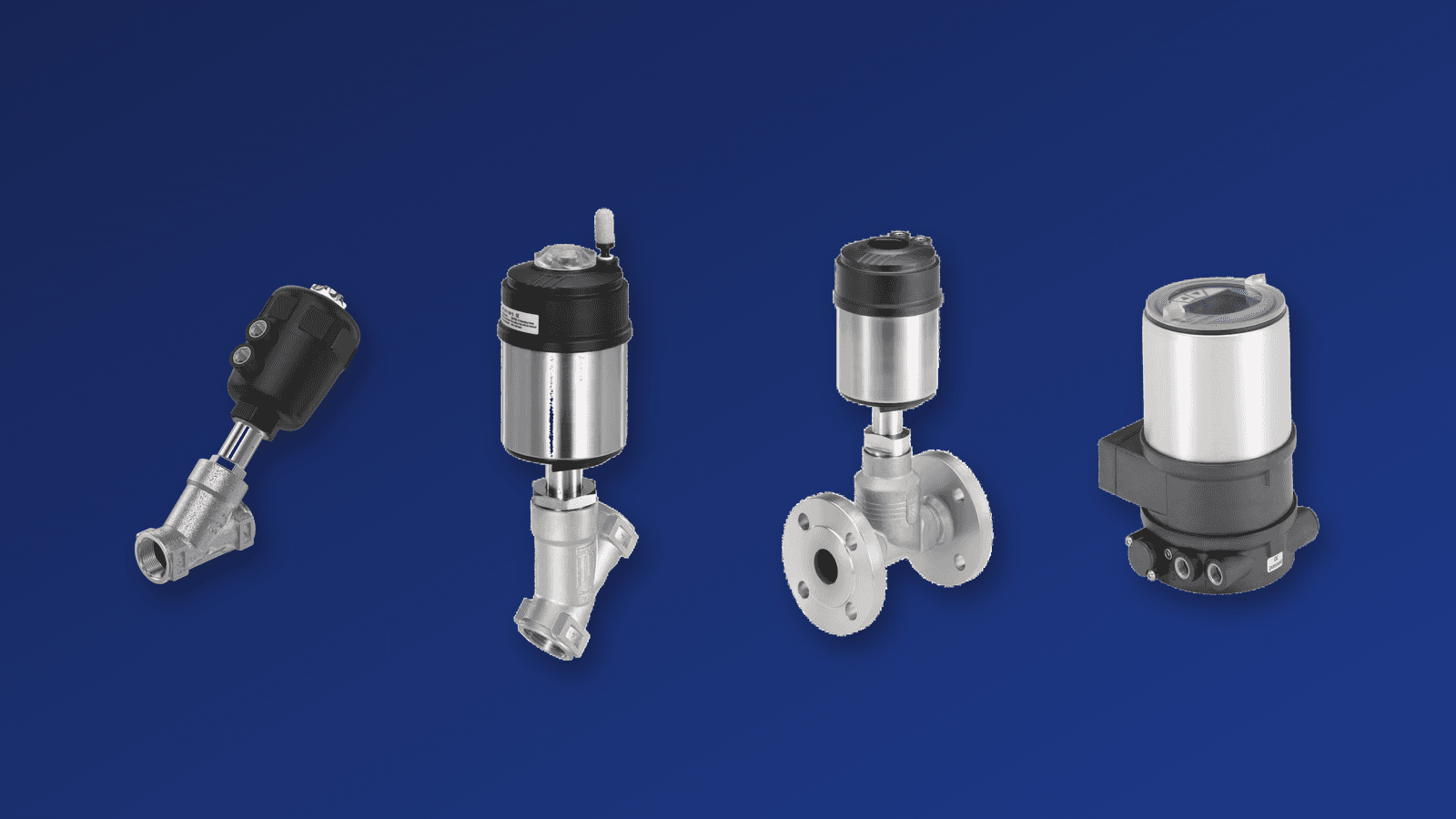
Angle seat valve vs globe valve is a choice that comes up on almost every steam, water and process line. Both are linear seat valves driven by a pneumatic piston actuator, but the body geometry changes flow capacity, control behaviour and installation. Pick the wrong one and you either oversize the valve or lose control quality at low flows.
This guide compares the two body styles using Bürkert's CLASSIC and ELEMENT ranges, from the Type 2000 angle seat valve to the Type 2301 globe control valve.
Angle seat valves: high flow for on/off duty
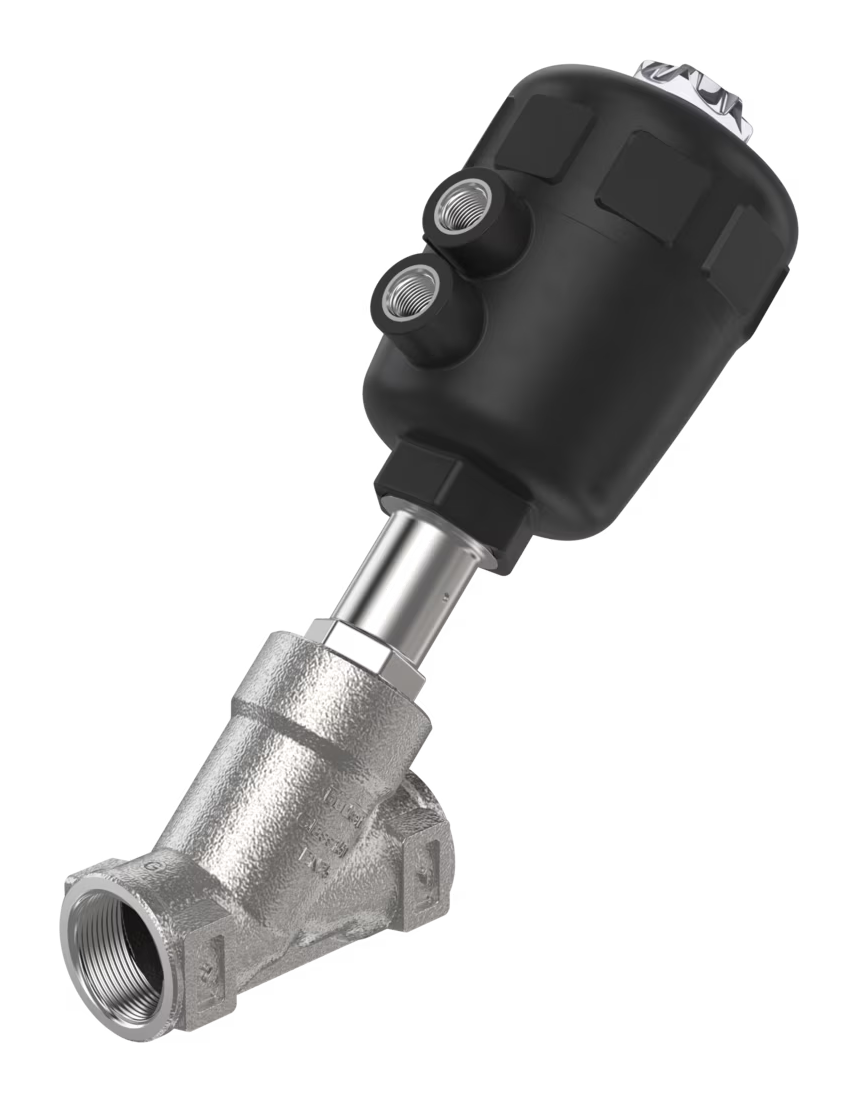
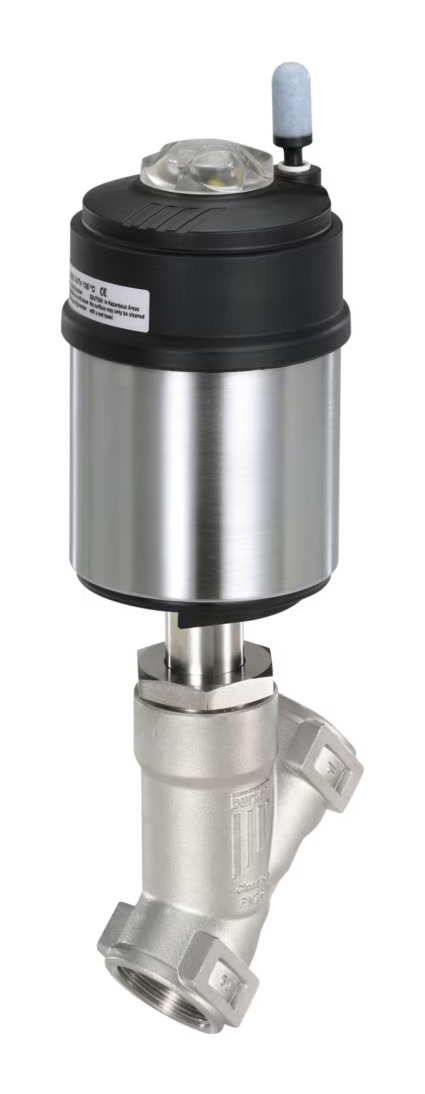
In an angle seat valve the actuator and stem sit at an angle to the pipe, so the flow path is relatively straight and unobstructed. The result is a high flow rate for the size, which is why angle seat valves are the default for steam, hot water, CIP and washdown isolation.
- The Bürkert Type 2000 CLASSIC combines a PA or PPS piston actuator with a flow-optimised stainless steel body (CF3M/316L or CF8/304) and a self-adjusting packing gland. Threaded, clamp, flange and weld ends are available, and accessories such as position indication and stroke limitation can be retrofitted.
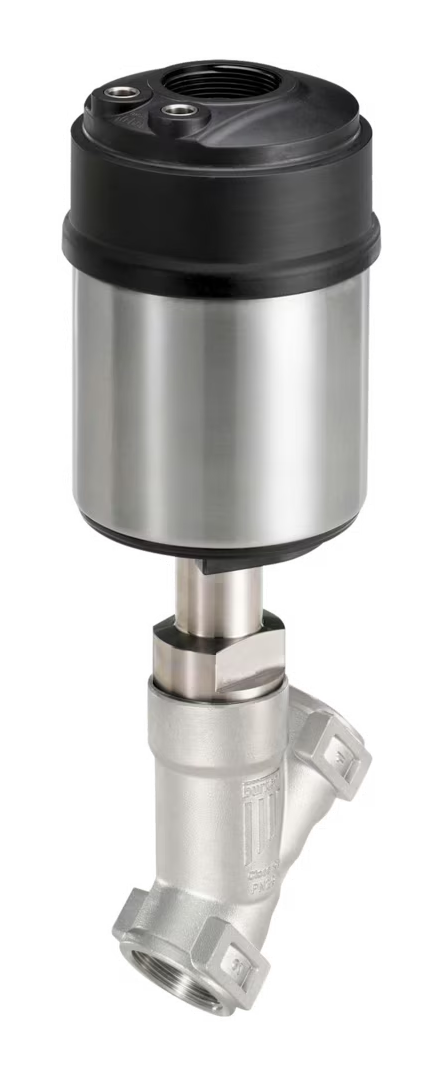
- The Type 2100 ELEMENT is optimised for decentralised automation. Control heads and positioners mount directly on the actuator with integrated pilot air ducts, and Bürkert lists IP65/67, NEMA 4X and a self-adjusting V-seal packing gland.
Globe valves: compact, bidirectional and controllable
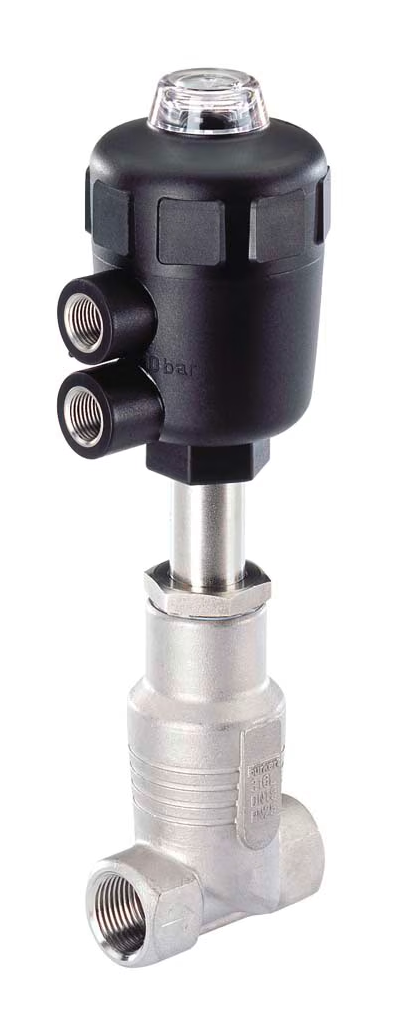
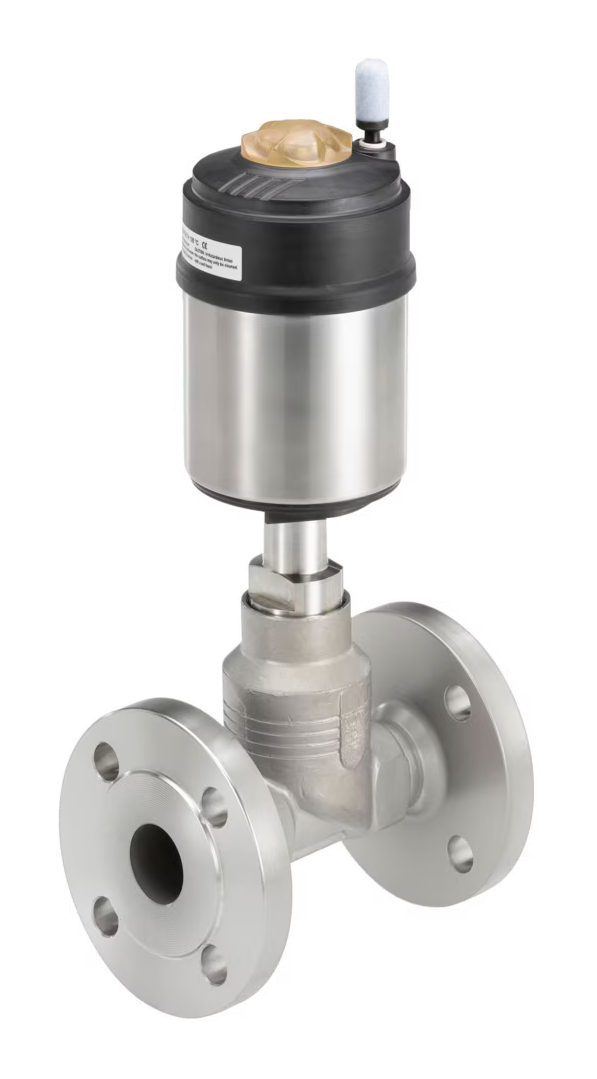
A globe valve turns the flow through the seat, which costs some capacity but gives a compact body and a well-defined seat geometry. The Type 2012 CLASSIC and Type 2101 ELEMENT are the globe-pattern on/off equivalents of the 2000 and 2100.
Control duty: Type 2300 vs Type 2301
For modulating control, Bürkert fits a parabolic trim and a positioner.
- The Type 2300 angle seat control valve uses a parabolic trim that Bürkert says gives a flow characteristic about 35% larger than conventional designs, combining good control characteristics with high flow rate.
- The Type 2301 globe control valve can take up to five trim sizes per body, giving several Kvs values per port size, with exchangeable V-seals in a self-adjusting spindle packing.
Choose the 2300 when capacity is the priority and the 2301 when you need precise control, interchangeable trims or the flexibility to re-trim later.
| Angle seat (2000 / 2100 / 2300) | Globe (2012 / 2101 / 2301) | |
|---|---|---|
| Flow capacity | Higher for the size | Lower, more compact body |
| On/off model | 2000 CLASSIC, 2100 ELEMENT | 2012 CLASSIC, 2101 ELEMENT |
| Control model | 2300 with parabolic trim | 2301 with up to five trim sizes |
| Typical duty | Steam, hot water, CIP, high-flow isolation | Precise flow, pressure and temperature control |
| Automation | ELEMENT control heads and positioners mount without external tubing | Same ELEMENT automation units |
Adding the positioner
A control valve needs a positioner or process controller. The Bürkert Type 8692 is a compact digital electropneumatic positioner for integrated mounting on Type 23xx and 2103 valves, with automatic X-Tune start-up, a contact-free position sensor and EtherNet/IP, PROFINET, Modbus TCP, PROFIBUS DP-V1 or büS options. If you prefer to buy the complete package, the Type 8802 ELEMENT control valve system pairs the valve with the positioner or controller.
When a diaphragm valve is better
Seat valves are not the answer for sterile, abrasive or highly corrosive media. For those, the Type 2103 ELEMENT diaphragm valve isolates the actuator from the medium with a diaphragm and a low-dead-space body.
Selection checklist
- Decide whether the duty is on/off or modulating control.
- For on/off and high flow, start with an angle seat valve (2000 or 2100).
- For control, choose the 2300 for capacity or the 2301 for precision and trim flexibility, then add an 8692 positioner.
- For sterile, slurry or aggressive media, consider a diaphragm valve such as the 2103.
- Confirm body material, end connection, pressure and temperature on the data sheet.
Territory Instruments can quote Bürkert process valves with the right actuator, trim and automation for your line.
Frequently asked questions
Is an angle seat valve a control valve?
A standard angle seat valve such as the Bürkert Type 2000 or 2100 is an on/off valve. Bürkert's Type 2300 is an angle seat control valve with a parabolic trim, designed for modulating duty with a positioner.
What is the difference between Bürkert CLASSIC and ELEMENT valves?
CLASSIC valves such as the 2000 and 2012 use a robust PA or PPS piston actuator with retrofit accessories. ELEMENT valves such as the 2100, 2101 and 2301 are designed for decentralised automation, with control heads and positioners mounted directly on the actuator and integrated pilot air ducts.
Can I change the Kvs of a Bürkert 2301?
Yes. Each 2301 globe valve body can be fitted with up to five trim sizes, so several Kvs values are available for one port size.
Which positioner fits a Bürkert 2301?
The Type 8692 digital positioner is designed for integrated mounting on Type 23xx and 2103 valves. Bürkert also offers the complete Type 8802 ELEMENT control valve system.